

Solution
-
 Jul 31/2026
How to Tackle Moderate Water Gushing in Deep Geological Drilling (500–600m Depth)
-
 Jul 30/2026
Geological Drilling & Drilling Fluid Terminology
-
 Jul 30/2026
Distinguishing Hole Contraction and Hole Collapse in Geological Drilling
-
 Jul 28/2026
Comprehensive Guide to Drilling Fluid Key Parameters, Testing Methods & Professional Mud Solutions
-
 Jun 28/2026
4 Key Formation-Specific Drilling Fluid Formulation Strategies for Small-caliber Geological Coring
Comprehensive Guide to Drilling Fluid Key Parameters, Testing Methods & Professional Mud Solutions
The Critical Role of Standardized Drilling Fluid Parameter Testing
What You Will Learn from This Blog:
- Complete definitions of all core drilling fluid performance indicators
- Step-by-step standard field and laboratory testing procedures for mud parameters
- Professional mud performance control solutions supported by proprietary drilling fluid additives
- Full-cycle drilling fluid technical service support from SanheRunjing Technology
Meta Description: Learn all core drilling fluid indicators, standard field & lab testing procedures. Sanhe Runjing Beijing supplies proprietary drilling fluid additives and full technical service for precise mud performance control.
Drilling fluid (drilling mud) is the vital working medium in well drilling. It cools and lubricates drill bits, carries rock cuttings to the surface, stabilizes unstable borehole walls, balances subsurface formation pressure and protects hydrocarbon reservoirs.
All drilling safety and efficiency rely on precise monitoring and regulation of drilling fluid performance indicators. Any out-of-spec parameter may trigger well collapse, stuck pipe, lost circulation, well kick or reservoir contamination. Below is a detailed breakdown of all fundamental drilling fluid parameters, their practical significance and complete standardized measurement methods adopted globally in oilfield labs and rig sites.
Mud Density (Mud Weight)
Definition
Mud density refers to the mass of drilling fluid per unit volume, expressed in g/cm³ or kg/m³. Appropriate density suppresses formation fluid pressure to avoid blowouts; excessive density will fracture fragile formations and cause lost circulation.
Complete Testing Method with Mud Balance
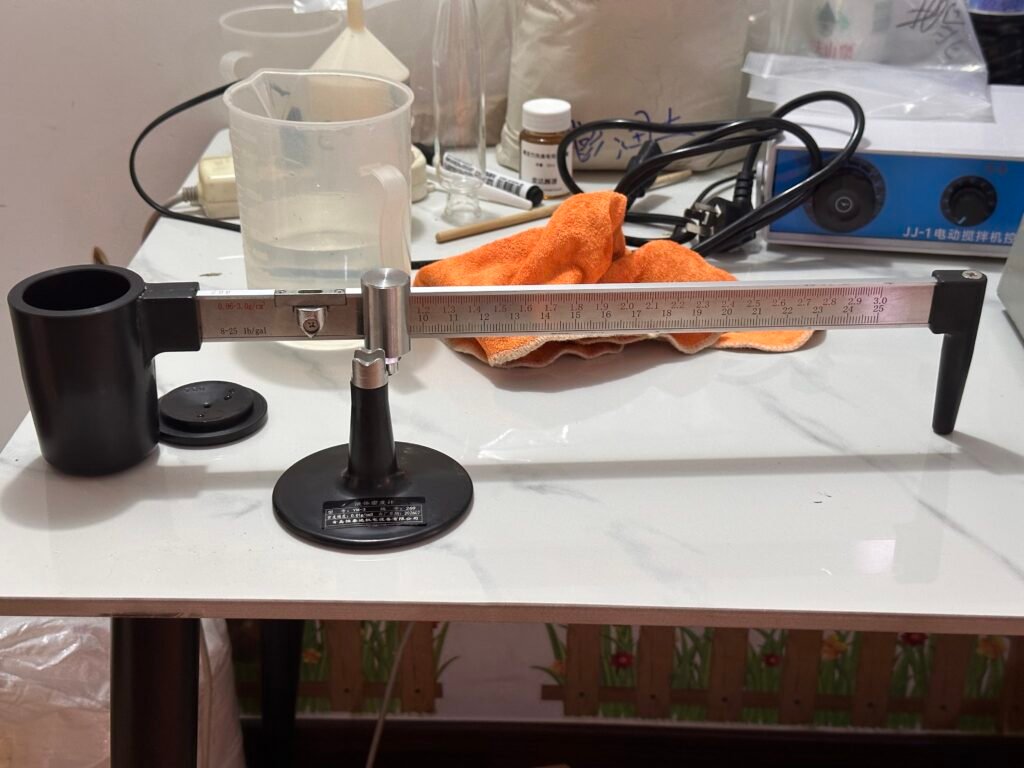
- Thoroughly clean and dry the mud cup, lid and graduated beam of the mud balance;
- Fill the metal cup completely with fresh, homogenized drilling fluid, fasten the lid tightly. Excess mud will flow out through the central vent hole;
- Wipe all spilled mud off the outer surface of the cup to eliminate measurement error;
- Place the balance’s fulcrum knife edge on the support stand; slide the counterweight rider along the graduated beam until the beam stays perfectly horizontal;
- Read the density value aligned with the left edge of the sliding rider;
Calibration step: Test pure clean water at room temperature. The reading should be 1.00 g/cm³. If there is deviation, adjust the lead counterweight inside the rider to calibrate the instrument.
Marsh Funnel Viscosity
Definition
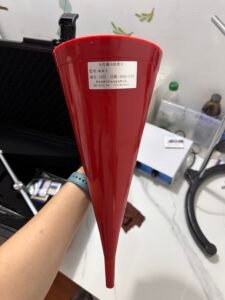
Marsh funnel viscosity represents the overall flow resistance of drilling fluid, recorded as the time (seconds) required for a fixed volume of mud to discharge from a standard funnel. It directly reflects the mud’s capacity to suspend rock cuttings and the circulating resistance for mud pumps.
Step-by-Step Test Procedure
 |
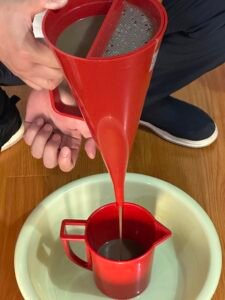 |
- Hold the standard Marsh funnel vertically, block the bottom discharge outlet with one finger;
- Pour freshly agitated drilling fluid through a standard sieve into the funnel until the liquid level reaches the marked internal calibration line;
- Prepare a standard 946 mL measuring cup under the funnel spout; release your finger and start a stopwatch simultaneously;
- Stop timing the moment the last drop of mud flows out of the funnel. The recorded seconds are the Marsh funnel viscosity;
Routine calibration: Clean water should flow out in 26 ± 0.5 seconds. Longer flow time indicates funnel blockage or deformation, requiring cleaning or instrument replacement.
Rheological Parameters via Six-Speed Rotational Viscometer
Core rheological indicators include Plastic Viscosity (PV), Yield Point (YP), 10-second initial gel strength and 10-minute final gel strength. These metrics determine the mud’s solid suspension property and pump startup pressure.
Full Testing Operation
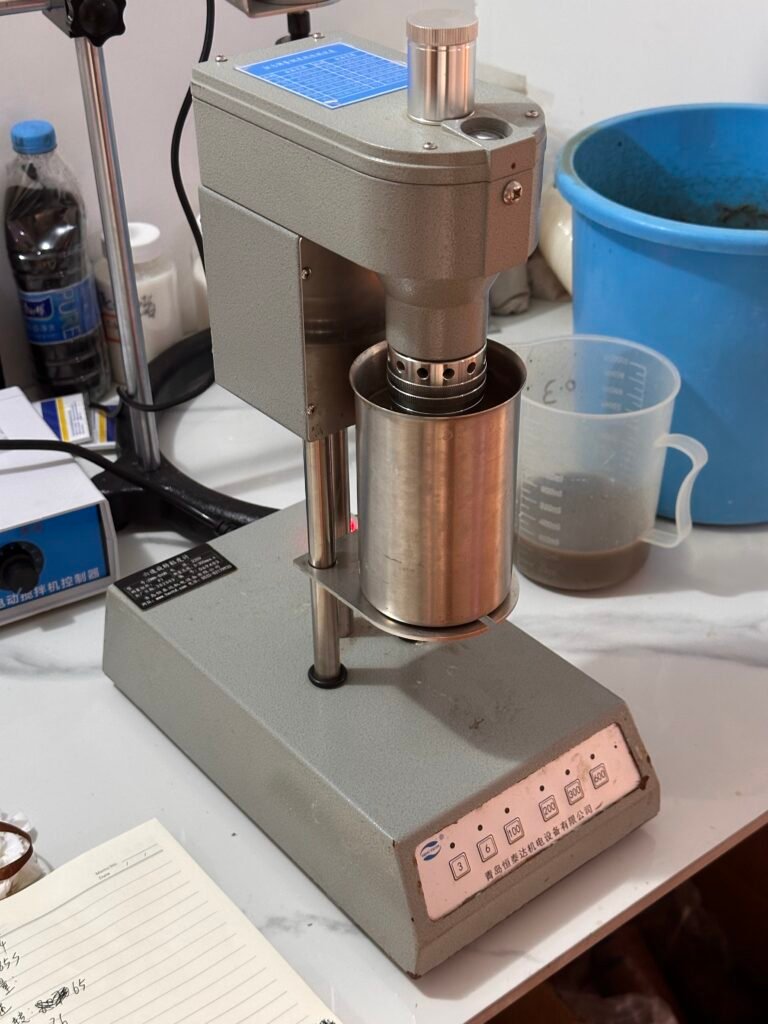
- Fill the viscometer measuring cylinder with well-stirred drilling fluid up to the designated liquid level mark;
- Run the instrument at maximum speed for 30 seconds to fully break down the mud’s natural gel network;
- Keep the viscometer running at 600 r/min until the dial reading stabilizes, record θ₆₀₀; switch to 300 r/min and record stable θ₃₀₀;
- Calculate Plastic Viscosity: PV = θ₆₀₀ − θ₃₀₀ (unit: mPa·s);
- Calculate Yield Point: YP = 0.48 × (θ₃₀₀ − PV) (unit: Pa);
- Test initial gel strength: After high-speed stirring, stop the machine and let the mud rest undisturbed for exactly 10 seconds. Slowly rotate the viscometer handwheel and record the maximum dial reading when the rotor first turns steadily, convert to gel strength value;
- Test final gel strength: Let the same mud sample stand for 10 minutes without agitation, repeat the gel strength measurement process to obtain the 10-min gel strength.
API Low-Pressure Fluid Loss & Mud Cake Thickness
Definition
Under fixed pressure, filtrate water seeps from drilling fluid into porous formations. The volume of collected filtrate after 30 minutes is API fluid loss. A thin, compact mud cake forms on filter paper to block further water invasion into the reservoir. High fluid loss leads to borehole collapse and formation damage.
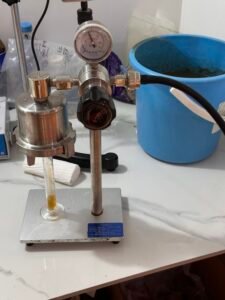
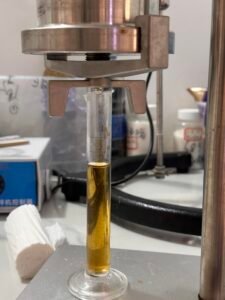
Standard API Filter Press Testing Process
 |
 |
 |
- Disassemble the filter cup, lay a standard filter paper flat at the bottom of the cup;
- Pour homogenized drilling fluid into the filter cup up to the internal scale line; fasten the top cover tightly and install the whole cup on the pressure support frame;
- Connect the air pressure pipeline, adjust the pressure gauge to maintain a constant test pressure of 0.69 MPa; start timing immediately after pressure stabilization;
- Place a graduated measuring cylinder under the filtrate outlet to collect all leaked liquid;
- Stop the test after exactly 30 minutes, close the air supply and release residual pressure slowly;
- Record the total filtrate volume as API fluid loss value;
- Remove the filter paper with formed mud cake, wipe free surface liquid gently, use a thin ruler to measure the average thickness of the solid mud cake layer, recorded in millimeters.
Sand Content
Definition
Sand content refers to the volume percentage of solid particles larger than 74 μm (200 mesh sieve) in drilling fluid. Excessive sand severely abrades mud pumps, drill pipes, drill bits and all downhole tools.
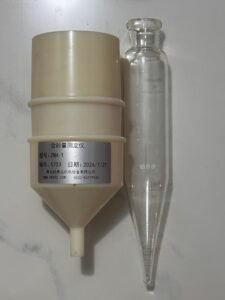
Complete Measurement Steps
 |
 |
- Add fresh drilling fluid to the 20 mL calibration line of the sand content measuring tube; fill the tube with clean water, cover the cap and shake vigorously for 1 minute to fully dilute and disperse mud solids;
- Mount the standard 200-mesh sieve funnel on top of the measuring tube, pour the diluted mud mixture through the sieve; rinse the measuring tube repeatedly with clean water and pour all liquid through the sieve;
- Wash the sieve surface continuously with clean water until all fine mud and bentonite particles flow through the mesh, leaving only coarse sand trapped on the screen;
- Reverse-flush the sieve with clean water to wash all residual sand particles down into the graduated measuring tube;
- Place the tube upright and wait for all sand to fully settle at the bottom; read the volume of settled sand from the tube scale;
- Sand content (%) = (settled sand volume ÷ 20) × 100%.
Total Solid Content (Distillation Method)
Definition
Total solid content is the volume fraction of all undissolved solids in mud, including bentonite, rock cuttings, weighting agents and inert solids. Overhigh solids increase circulation pressure and worsen filtration performance.
Distillation Test Procedure
- Pipette an exact 20 mL drilling fluid sample into the distillation metal cup;
- Install the condensation tube and receiving graduated cylinder, seal all connecting joints tightly to prevent steam leakage;
- Turn on the heating device to heat the mud sample until all liquid phase (water/oil) evaporates and condenses into the receiving cylinder;
- Once no more liquid drips from the condenser, cut off the heat source and cool the device to room temperature;
- Read the volume of condensed liquid; total solid volume = 20 mL − condensed liquid volume; calculate solid volume percentage accordingly;
Advanced calculation: The distillation data can further separate and calculate the independent content of weighting solids, low-density bentonite and rock debris.
pH Value of Drilling Fluid
Definition
pH value indicates the acidity and alkalinity of mud. The optimal operating range for water-based drilling fluid is 8.5–10.5. Acidic mud accelerates metal tool corrosion and destabilizes mud additives; overly strong alkaline mud damages oil and gas reservoirs.
Two Widely Used Testing Methods
Method 1: pH Test Strips (On-Site Rapid Detection)
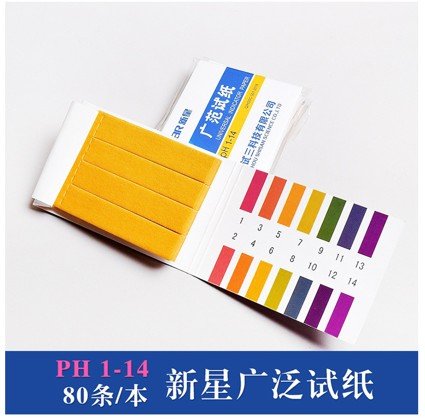
- Drop a small amount of fresh drilling fluid filtrate onto the reaction area of a pH test strip;
- Wait 30 seconds for the strip color to fully develop;
- Compare the strip color against the standard color chart printed on the strip packaging to read the pH value.
Method 2: Portable Digital pH Meter (Laboratory High-Precision Test)
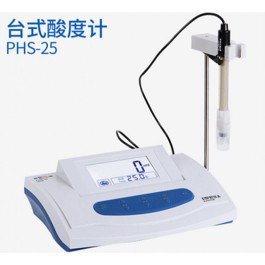
- Calibrate the pH meter with standard buffer solutions (pH 7 and pH 10) before measurement;
- Rinse the electrode probe with clean water and wipe dry;
- Submerge the electrode into drilling fluid filtrate, gently stir the liquid sample;
- Wait for the digital reading to stabilize, directly record the displayed pH number;
- Clean the electrode thoroughly after each test and store it as instructed.
Chloride Ion Content (Silver Nitrate Titration)
Definition
Chloride ion concentration (mg/L) reflects saline formation water contamination. Salt intrusion breaks the hydration structure of bentonite and completely deteriorates mud performance.
Standard Titration Testing Steps
- Extract clear filtrate from drilling fluid via filter paper, take a fixed volume of filtrate into a titration beaker;
- Add phenolphthalein indicator to neutralize excess alkalinity, then add potassium chromate as the end-point indicator;
- Fill a burette with standardized silver nitrate titrant, record the initial burette reading;
- Slowly drip silver nitrate solution into the filtrate while continuously stirring the liquid;
- Stop titration the moment the liquid turns faint brick-red and the color remains stable; record the final burette reading;
- Calculate chloride ion concentration based on the consumed volume of silver nitrate reagent and standard solution concentration.
Alkalinity (P-Alkalinity & M-Alkalinity)
Definition
Alkalinity quantifies alkaline substances in mud filtrate, guiding accurate dosing of caustic soda, lime and other alkaline mud additives to control corrosion and mud stability.
Double Indicator Titration Method
- Collect mud filtrate sample and pour into a conical flask;
- Add phenolphthalein indicator and titrate with standard dilute sulfuric acid until the pink color completely fades; record acid consumption volume to calculate P-Alkalinity;
- Add methyl orange indicator to the same sample, continue titration until the liquid turns orange-red; record total acid consumption for M-Alkalinity calculation.
ABOUT SanheRunjing Technology Co., Ltd.
Headquartered in Beijing, SanheRunjing Technology Co., Ltd. focuses on drilling fluid material research & development, comprehensive drilling fluid technical services and full-process drilling construction support.
We own independent intellectual property rights and exclusive proprietary mud technologies, alongside a self-built standardized production base that manufactures a complete series of drilling fluid treatment agents. Our professional technical team provides customers with one-stop guidance on drilling fluid parameter testing, mud system formulation design and on-site abnormal performance troubleshooting.
Combining in-depth mastery of all standard mud testing procedures with self-developed high-performance additives, we help drilling crews maintain all key mud parameters within the ideal safe range, reduce downhole risks and cut overall drilling operation costs.
Contact Us
Company Name: SanheRunjing Technology Co., Ltd.
Core Business: R&D & production of drilling fluid additives, drilling fluid testing technical guidance, drilling construction technical service
Location: Room 305, 3rd Floor, Building 1, Yard 7, Guangyang New Road, Fangshan District, Beijing, China
Check out other recent news:
4 Key Formation-Specific Drilling Fluid Formulation Strategies for Small-caliber Geological Coring
5 Hidden Drilling Fluid Roadblocks Plaguing Small-caliber Geological Drilling