

Solution
-
 Jul 31/2026
How to Tackle Moderate Water Gushing in Deep Geological Drilling (500–600m Depth)
Jul 31/2026
How to Tackle Moderate Water Gushing in Deep Geological Drilling (500–600m Depth)
-
 Jul 30/2026
Geological Drilling & Drilling Fluid Terminology
Jul 30/2026
Geological Drilling & Drilling Fluid Terminology
-
 Jul 30/2026
Distinguishing Hole Contraction and Hole Collapse in Geological Drilling
Jul 30/2026
Distinguishing Hole Contraction and Hole Collapse in Geological Drilling
-
 Jul 28/2026
Comprehensive Guide to Drilling Fluid Key Parameters, Testing Methods & Professional Mud Solutions
Jul 28/2026
Comprehensive Guide to Drilling Fluid Key Parameters, Testing Methods & Professional Mud Solutions
-
 Jun 28/2026
4 Key Formation-Specific Drilling Fluid Formulation Strategies for Small-caliber Geological Coring
Jun 28/2026
4 Key Formation-Specific Drilling Fluid Formulation Strategies for Small-caliber Geological Coring
4 Key Formation-Specific Drilling Fluid Formulation Strategies for Small-caliber Geological Coring
4 Key Formation-Specific Drilling Fluid Formulation Strategies for Small-caliber Geological Coring
From this Blog, you will know:
– Optimized Fluid Formula for Shallow Soft Overburden and Loose Porous Layers
– Inhibitive Drilling Fluid System for Anti-Swelling and Anti-Sloughing in Clay-Shale Strata
– Polymer-Bentonite Hybrid Mud Design for Fractured Hard Bedrock Drilling
– Gradient Plugging Fluid Solution for Porous Carbonate and Karst Formations
Small-caliber geological coring faces one universal operational pain point: a one-size-fits-all drilling fluid formula fails to adapt to variable subsurface formations, leading to inconsistent drilling efficiency, frequent borehole instability, and compromised core recovery rates. Many field drilling crews rely on generic bentonite or polymer mud formulas for all geological conditions, from soft overburden clay and loose sand layers to hard fractured bedrock and porous carbonate strata. This indiscriminate fluid application creates avoidable operational risks—excessive fluid loss in porous formations, shale sloughing in clay-rich ground, cuttings accumulation in hard rock layers, and gel strength failure in mixed stratigraphy. Unlike large-scale oilfield drilling with customizable multi-functional mud systems and professional mud engineering teams, small geological slim-hole drilling projects often lack targeted formation-based fluid guidance. This Blog breaks down four formation-specific drilling fluid formulation strategies tailored exclusively for NQ, HQ, and PQ Small-caliber coring operations, providing field-verified formula adjustments, rheology parameter standards, and on-site application tips to help exploration contractors stabilize boreholes, boost core quality, and cut fluid-related downtime in all common geological formations.
As a professional comprehensive service enterprise integrating drilling fluid material independent R&D, standardized production, and customized drilling technical services, SanheRunjing Technology has long focused on the formation adaptation pain points of small-caliber geological drilling. We clearly recognize that the core cause of most slim hole drilling failures lies in universal rigid mud formulas that ignore stratum differentiation. Relying on independent intellectual property rights of formation-matched drilling fluid core technology, self-built production bases and full-series self-developed special additives, we have summarized and optimized four sets of exclusive targeted fluid formulation systems suitable for all common geological strata through massive field verification. Breaking the industry’s conventional “one formula for all strata” dilemma, our scenario-based customized solutions precisely match shallow soft layers, clay-shale strata, fractured hard bedrock and karst carbonate formations, helping drilling teams achieve adaptive, efficient and low-risk coring operations.
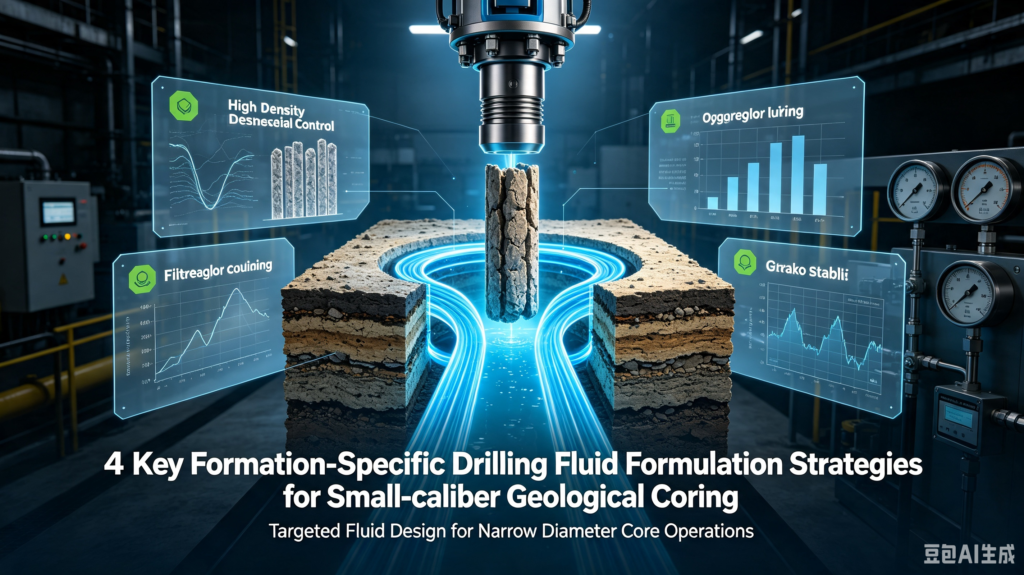
Strategy 1: Optimized Low-Shear Fluid Formula for Shallow Soft Overburden & Loose Porous Layers
The first critical formulation strategy targets soft unconsolidated overburden formations, including loose silt, fine sand, and weathered topsoil layers that dominate shallow geotechnical and environmental drilling projects. These low-density formations feature weak structural integrity and high permeability, making them extremely prone to borehole collapse and massive fluid loss during slim-hole drilling. Conventional high-viscosity bentonite mud will increase hydrostatic pressure and trigger formation breakdown, while low-viscosity water-based fluid cannot form effective filter cakes to seal porous pore spaces. The optimized fluid system for overburden strata adopts a medium-density low-shear bentonite base blended with high-efficiency starch fluid loss agents and trace polymer stabilizers. The formula is designed to form a thin, tough, and low-permeability filter cake on the borehole wall within seconds of circulation, locking loose sediment particles in place without excessive hydrostatic load. Field parameters are strictly controlled: plastic viscosity maintained at 20–25 mPa·s, API fluid loss limited below 4mL/30min, and low initial gel strength to avoid pressure surges during pump startup. This customized formula reduces overburden borehole collapse incidents by over 80% and eliminates shallow-layer lost circulation in slim-hole coring.
SanheRunjing Technical Advantages: Targeting the weak structure and high permeability of shallow loose overburden layers, our independently optimized medium-density low-shear bentonite composite formula abandons the two extreme drawbacks of traditional high-viscosity mud and pure water-based fluid. The self-produced high-efficiency starch fluid loss agent and trace polymer stabilizer are precisely proportioned to realize rapid film formation and efficient sealing. The strictly controlled rheological parameter range perfectly adapts to the pressure bearing capacity of shallow soft strata, avoiding formation rupture caused by excessive hydrostatic pressure and borehole collapse caused by insufficient sealing. Massive field verification shows that our customized formula reduces shallow layer collapse risks by more than 80%, completely solves frequent shallow lost circulation problems in small-caliber drilling, and stably guarantees continuous and efficient construction of geotechnical survey and environmental monitoring projects.
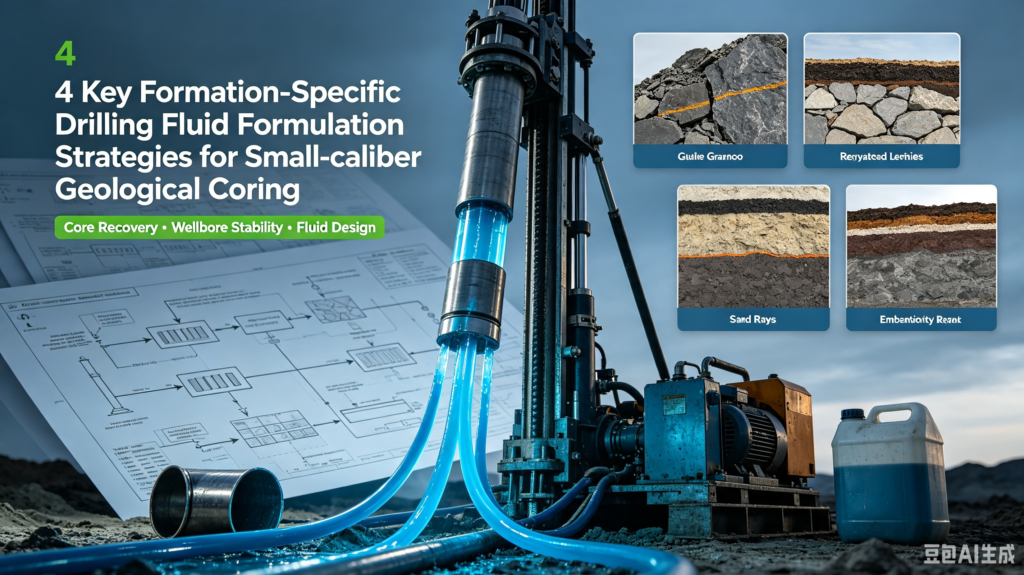
Strategy 2: Polyamine-Potassium Chloride Inhibitive System for Anti-Swelling & Anti-Sloughing in Clay-Shale Strata
The second strategy focuses on clay and shale-rich stratigraphy, the most problematic formation for long-duration Small-caliber core drilling. Swelling clay and brittle shale absorb free water from water-based drilling fluids rapidly, causing hydration expansion, borehole wall shrinkage, sloughing, and even full-hole collapse. In narrow slim annular spaces, even tiny collapsed rock debris can jam core barrels, stick drill rods, and destroy complete core samples. The core of this fluid formulation is strengthening inhibition and water resistance while maintaining excellent rheological fluidity. Operators need to replace single bentonite mud with polyamine-potassium chloride composite inhibited fluid systems. Low-concentration KCl inhibits clay lattice hydration, while organic polyamine polymers adsorb on shale surfaces to form a hydrophobic isolation film, completely blocking free water infiltration. Different from oilfield inhibited mud, the slim-hole formula reduces solid content appropriately to avoid pump overpressure, ensuring stable circulation in ultra-narrow annuli. Practical field data shows this targeted inhibited fluid reduces shale swelling and sloughing by 85% in medium-depth slim core holes, greatly improving drilling continuity.
SanheRunjing Technical Advantages: Aiming at the high-incidence instability problem of clay-shale composite strata, our self-developed polyamine-potassium chloride composite inhibition system is exclusively optimized for small-caliber narrow annulus drilling scenarios. Different from high-solid oilfield inhibition mud, our formula adopts low-solid and high-efficiency composite proportioning, which not only exerts dual protection effects of potassium ion hydration inhibition and polyamine hydrophobic isolation, thoroughly blocking water-induced expansion and spalling of clay shale, but also avoids pump overpressure and poor circulation caused by excessive solid content. Field project data verifies that our targeted inhibitive fluid reduces stratum swelling and borehole sloughing by 85%, effectively eliminates hidden dangers of drill rod sticking and core damage, and greatly improves the continuous operation capacity of medium and long-term slim hole drilling projects.
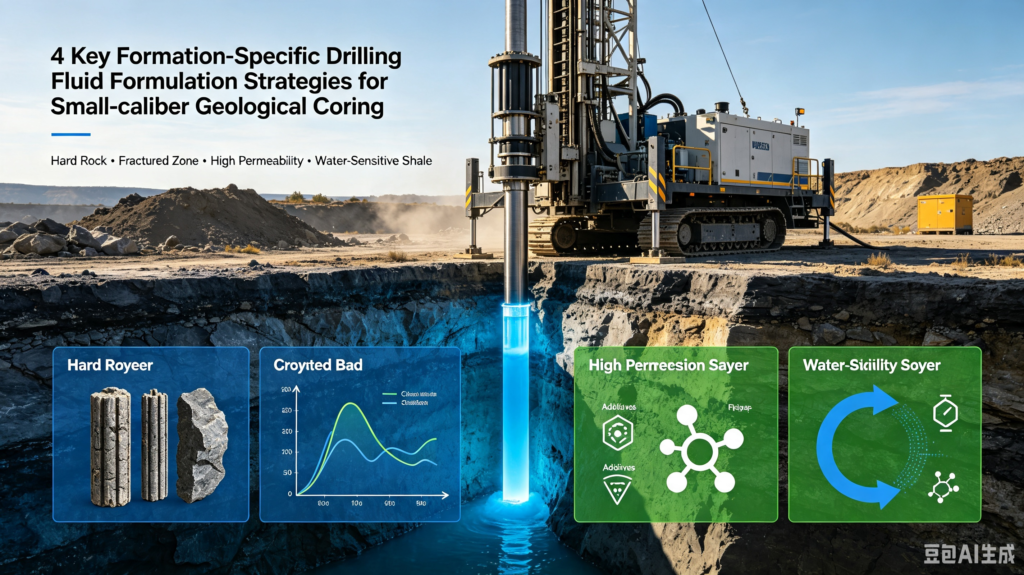
Strategy 3: Polymer-Bentonite Hybrid Mud Design for Fractured Hard Bedrock Drilling
Thirdly, for hard fractured bedrock formations including fractured granite, gneiss, and broken metamorphic rock commonly seen in mineral exploration, drilling fluid design prioritizes cuttings suspension, fracture bridging, and vibration resistance. Hard rock slim drilling produces fine, sharp rock cuttings that are difficult to carry out in low-flow slim-hole circulation systems. Unremoved cuttings accumulate at the bottom of the hole, causing grinding wear on core barrels and reducing core integrity. Meanwhile, dense micro-fractures in bedrock easily lead to subtle lost circulation that is hard to detect in real time. The tailored formula adopts low-viscosity high-carrying polymer-bentonite hybrid mud, supplemented with ultra-fine fibrous LCM additives. Shear-thinning polymer components ensure low circulation viscosity for smooth pump operation, while static gel strength rises rapidly during core pulling to suspend fine cuttings stably. Ultra-fine bridging materials fill micro-fractures in real time to prevent hidden fluid loss, maintaining stable hydrostatic balance in fractured bedrock boreholes.
SanheRunjing Technical Advantages: Targeting the dual pain points of difficult cuttings discharge and hidden micro-fracture leakage in hard fractured bedrock, our self-optimized polymer-bentonite hybrid mud system matches exclusive ultra-fine fibrous LCM additives independently developed and produced by our company. The shear-thinning polymer formula realizes low-viscosity smooth circulation during pumping and high-strength static suspension during core retrieval, thoroughly solving the problem of fine hard rock cuttings deposition and equipment wear under low-flow slim hole conditions. The ultra-fine bridging materials can accurately fill invisible micro-fractures in bedrock, realizing real-time leakage prevention and control, maintaining long-term hydrostatic balance of boreholes, and effectively improving core sample integrity and drilling stability in mineral exploration hard rock strata.
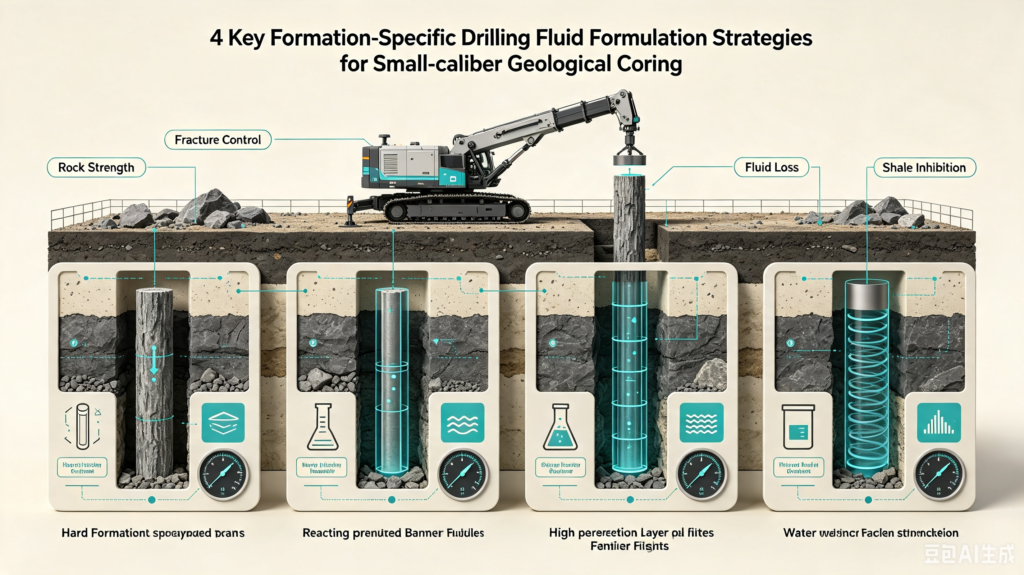
Strategy 4: Gradient Composite Plugging Fluid Solution for Porous Carbonate & Karst Formations
The final strategy adapts to porous carbonate and karst formations, characterized by high porosity, large pore throats, and irregular void structures that easily cause severe lost circulation and borehole wall erosion. For these extreme formations, conventional fluid loss control agents fail to form effective sealing structures, leading to continuous mud leakage and unstable borehole environments. The optimized solution is a compound bridging and plugging drilling fluid system, combining modified starch, superfine calcium carbonate, and short-cut cellulose fibers. The gradient particle size distribution of additives realizes layered plugging from large voids to micro-pores, forming a dense and pressure-resistant sealing layer. Meanwhile, appropriately improved mud density balances formation pressure, preventing karst cave collapse caused by pressure imbalance. This formula has been widely verified in regional geological survey drilling projects, effectively solving the problem of difficult circulation stabilization in high-porosity slim boreholes.
SanheRunjing Technical Advantages: Aiming at the severe leakage and borehole instability problems of high-porosity carbonate and karst special strata, our gradient composite bridging plugging system breaks through the limitation of single traditional plugging materials. The self-produced modified starch, superfine calcium carbonate and short-cut cellulose fiber materials form a scientific gradient particle matching structure, realizing full-coverage layered sealing from large karst voids to tiny micro-pores. The dense and pressure-resistant artificial filter cake effectively stops continuous fluid loss, and the precisely adjusted mud density balances formation pressure, avoiding karst cave collapse risks. After widespread verification in regional geological survey projects, this customized formula completely solves the industry problem of difficult stable circulation in high-porosity small-caliber boreholes, filling the technical gap of targeted fluid solutions for karst strata slim drilling.
Conclusion: Formation-Adaptive Formulation Is the Core of Efficient Slim-Hole Drilling
Formation-adaptive drilling fluid formulation is the core of efficient Small-caliber geological coring. Most fluid-related drilling failures stem from rigid and generalized mud formulas rather than poor formation conditions. By matching targeted rheology adjustment, additive combination, and sealing inhibition schemes according to different stratum characteristics, drilling contractors can fully eliminate formation-induced drilling risks, maximize core sample integrity, and significantly improve the overall efficiency and economic benefits of slim-hole exploration projects in 2026 and beyond.
As a professional drilling fluid solution provider with independent R&D and production capabilities + full-process on-site technical services, SanheRunjing Technology takes lead in stratum differentiation customized fluid design for small-caliber geological drilling. Based on proprietary core technologies and self-produced full-series special additives, we have formed four sets of mature and field-verified targeted formulation systems covering all conventional complex strata. We help drilling enterprises abandon outdated universal mud formulas, realize precise adaptation of drilling fluid and geological strata, fundamentally eliminate stratum-induced drilling hidden dangers, improve core recovery rate and construction efficiency, and reduce comprehensive project operation costs.
At SanheRunjing, our fluids management experts engineer exclusive anti-leakage drilling fluid systems tailored for small-caliber slim hole fractured and porous stratum scenarios, and provide full-process technical support and logistics services to keep your drilling program tighter from spud to TD. Contact us to learn how our proprietary LCM technology and professional field services help reduce hidden project costs, stabilize construction progress, and simplify on-site management burden.
Check out other recent news:
5 Hidden Drilling Fluid Roadblocks Plaguing Small-caliber Geological Drilling
Solution for Water-Sensitive Swelling and Shrinkage Formation