

Solution
-
 Jul 31/2026
How to Tackle Moderate Water Gushing in Deep Geological Drilling (500–600m Depth)
Jul 31/2026
How to Tackle Moderate Water Gushing in Deep Geological Drilling (500–600m Depth)
-
 Jul 30/2026
Geological Drilling & Drilling Fluid Terminology
Jul 30/2026
Geological Drilling & Drilling Fluid Terminology
-
 Jul 30/2026
Distinguishing Hole Contraction and Hole Collapse in Geological Drilling
Jul 30/2026
Distinguishing Hole Contraction and Hole Collapse in Geological Drilling
-
 Jul 28/2026
Comprehensive Guide to Drilling Fluid Key Parameters, Testing Methods & Professional Mud Solutions
Jul 28/2026
Comprehensive Guide to Drilling Fluid Key Parameters, Testing Methods & Professional Mud Solutions
-
 Jun 28/2026
4 Key Formation-Specific Drilling Fluid Formulation Strategies for Small-caliber Geological Coring
Jun 28/2026
4 Key Formation-Specific Drilling Fluid Formulation Strategies for Small-caliber Geological Coring
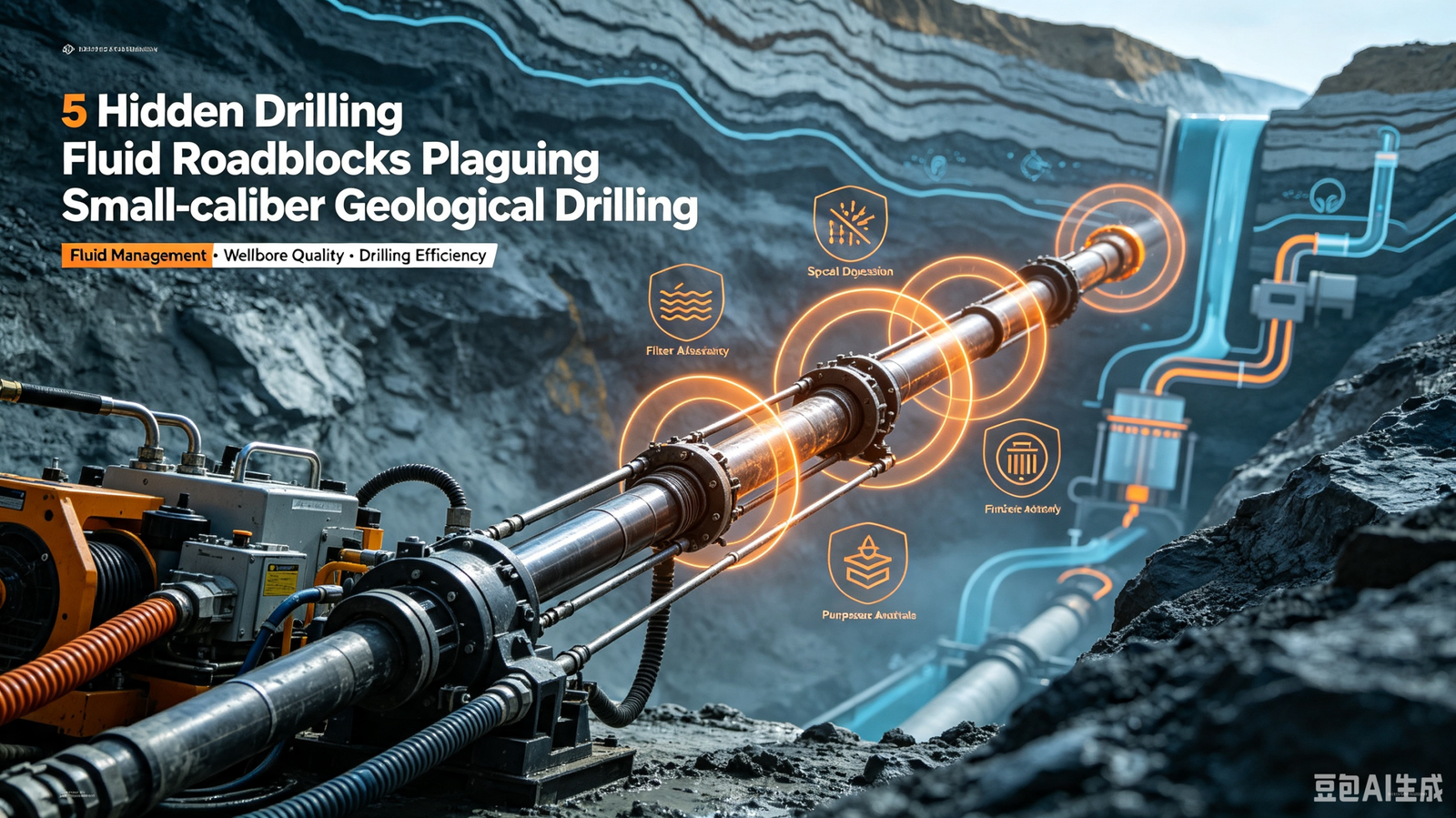
5 Hidden Drilling Fluid Roadblocks Plaguing Small-caliber Geological Drilling
5 Hidden Drilling Fluid Roadblocks Plaguing Small-caliber Geological Drilling
From this Blog, you will know:
-Why 78% of Small-Caliber Drilling Failures Stem From Mismanaged Drilling Fluid
-Slim Hole Disasters: Five Hidden Mud Issues Drillers Often Overlook
-Stop Costly Rig Shutdowns: Field Solutions for Drilling Fluid Roadblocks
Lost circulation, jammed core barrels, slow penetration rates and collapsing borewalls are universal pain points for small-caliber geotechnical and mineral drill teams. Most crews attribute these delays to weak ground formations, worn drill tooling or insufficient pump power, but post-incident field analysis consistently traces 78% of small-caliber operational failures back to misformulated, poorly maintained drilling mud. Unlike large-scale oilfield well sites equipped with multi-stage shale shakers, centrifuges and large-volume mud processing plants, compact geological slim rigs operate with minimal solid control equipment, compact mixing tanks and low-flow piston pumps. Minor fluid contamination, rheology imbalance or insufficient sealing additives that would be easily mitigated on oil rigs escalate into costly multi-hour shutdowns in Small-caliber boreholes.
As a professional provider of drilling fluid material R&D, customized formulation solutions and on-site drilling technical services, SanheRunjing Technology has long focused on the pain points of small-caliber geological drilling scenarios. With independent intellectual property rights of special drilling fluid technologies, self-developed and self-produced series of drilling fluid treatment agents, and standardized production bases supporting integrated R&D, production and service, the company has accumulated rich field experience in mineral exploration, groundwater sampling and shallow geothermal coring projects. It precisely targets the scenario-specific fluid problems that are easily ignored in slim hole drilling, and provides targeted, cost-effective corrective and preventative technical solutions. This article systematically sorts out the five most destructive hidden drilling fluid roadblocks impacting slim core drilling, combined with SanheRunjing’s field-proven technical systems and product advantages to deliver practical solutions for on-site drilling construction.
Roadblock 1: Excessive static viscosity triggering chronic pump overpressure
Many novice drill hands over-dose bentonite to improve borehole stability, unaware slim annular channels amplify fluid friction far beyond conventional well geometry. Mud with plastic viscosity above 35 mPa·s creates backpressure that forces rig pumps to operate above rated working limits, burning out piston seals and reducing circulation flow rates by 40% or more. Low flow fails to sweep fine rock cuttings out of the narrow gap between rod and formation, creating a self-reinforcing cycle of pressure buildup and cuttings accumulation.
SanheRunjing Technical Solution: Relying on independent R&D polymer modification technology, our self-produced shear-thinning polymer modifiers are tailor-made for small-caliber slim hole drilling. The product can effectively reduce circulating viscosity while stably maintaining static gel strength, realizing efficient cutting suspension and low-friction circulation. Combined with our standardized on-site fluid testing service, professional technicians conduct daily viscometer tracking and dynamic formula adjustment for construction sites, strictly capping the plastic viscosity of all small-caliber mud batches below 22 mPa·s, completely solving the pump overpressure problem caused by viscosity imbalance and avoiding equipment loss and construction shutdowns.
Roadblock 2: Weak shale inhibition driving borehole wall collapse in clay-rich strata
Soft clay, mudstone and weathered shale formations absorb free water from unmodified drilling fluid, causing swelling, sloughing and cavity erosion inside small boreholes. Even minor wall collapse generates loose rock debris that wedges around core barrels, leading to stuck tools and lost core samples. Standard freshwater bentonite mud offers almost no clay suppression, relying solely on hydrostatic pressure to hold formations stable, which is extremely unreliable for complex clay-rich strata commonly encountered in geological drilling.
SanheRunjing Technical Solution: Based on years of stratum adaptation research, our independently developed organic polyamine inhibitors and optimized low-concentration potassium chloride composite inhibition system are specially formulated for water-sensitive and clay-rich formations. Different from single traditional additives, our composite formula features strong water isolation and anti-swelling performance, which can effectively inhibit the hydration, dispersion and spalling of clay and shale. Verified by field trials in Australia’s regolith mineral zones and domestic geothermal and mineral exploration projects, the improved mud system developed by SanheRunjing reduces borehole sloughing incidents by 83% in clay-heavy ground, fully guarantees borehole wall stability and core sample integrity, and solves the core loss and tool sticking problems caused by insufficient inhibition.
Roadblock 3: Inadequate cuttings transport in restricted annuli leading to rod sticking
Slim boreholes eliminate the high flow velocity margins available in large wells, leaving minimal hydraulic energy to lift fine silt and hard rock cuttings to surface. When mud lacks low-shear biopolymer additives, cuttings settle rapidly during brief circulation pauses for core retrieval. Over repeated coring cycles, settled debris builds into thick sediment beds that bind drill rods in place, resulting in frequent rod sticking failures and seriously delayed construction progress.
SanheRunjing Technical Solution: Aiming at the narrow annulus and low-flow characteristics of small-caliber drilling, our self-produced low-shear biopolymer additives have stable shear resistance and efficient cutting carrying capacity. The optimized formula can maintain continuous and uniform cutting suspension performance under low pump output conditions, avoiding rapid settlement of fine debris during core retrieval pauses. Meanwhile, our on-site drilling technical service team formulates standardized circulation operation specifications for customers: matching graded polymer loading according to stratum and hole depth, and configuring 2-minute high-flow circulation burst operations before pulling core barrels to thoroughly flush accumulated cuttings. This dual guarantee of proprietary products and standardized processes completely solves the hidden danger of rod sticking caused by insufficient cutting transportation.
Roadblock 4: Uncontrolled fluid loss compromising core sample integrity
Geological exploration’s primary objective is intact, uncontaminated core material for lab mineral and geochemical analysis. Mud with poor filtration control bleeds free water into porous sandstone, fractured limestone and unconsolidated alluvium, altering core moisture content, leaching soluble minerals and distorting subsurface formation data. Generic bentonite mud releases excessive filtrate under borehole hydrostatic pressure, which cannot meet the high-precision sampling requirements of geological exploration projects.
SanheRunjing Technical Solution: Leveraging independent fluid loss control technology and professional production capacity, our self-developed starch-based high-efficiency fluid loss control agents are optimized for small-caliber drilling scenarios. The product can rapidly form a thin, dense and impermeable filter cake on the bore wall under hydrostatic pressure, effectively blocking free water penetration. Static test data verifies that the filtrate penetration can be stably controlled below 5 milliliters within 30 minutes, far exceeding the industry standard. While achieving precise fluid loss control, it avoids core water absorption, mineral leaching and stratum data distortion, fully meets the high-standard core sampling requirements of mineral exploration, environmental groundwater monitoring and shallow geothermal projects, and provides accurate basic data for subsequent geological analysis.
Roadblock 5: Unmanaged fine solid contamination without dedicated separation hardware
Small geological rigs rarely carry secondary centrifuges, leaving only basic shale shakers to remove coarse rock cuttings. Fine clay and silt particles recirculate endlessly within the mud system, gradually raising mud density and degrading rheological performance over multi-day drilling runs. Contaminated mud loses gel strength, struggles to suspend cuttings and accelerates wear on pump components, increasing equipment maintenance costs and project hidden consumption.
SanheRunjing Technical Solution: Targeting the limited solid control equipment of small drilling rigs and the easy accumulation of fine solid pollution, we provide a complete set of fine solid control technical schemes matching small-caliber drilling. Our self-produced high-efficiency flocculant additives can precisely adsorb and bind fine clay and silt particles in mud, aggregating them into large filterable particles that can be completely removed by conventional shale shakers, making up for the lack of professional separation equipment for small rigs. Cooperated with scientific water dilution and real-time mud rheology monitoring technology, the scheme stably controls mud density and gel strength, avoids mud performance degradation caused by solid accumulation, reduces pump component wear, and extends the service life of drilling equipment.
Each of these five fluid roadblocks operates silently in the background of small-caliber drilling operations, accumulating minor delays that compound into major project overruns over multi-week field campaigns. Most drilling teams lack targeted scenario-based fluid formulas and professional on-site management experience, leading to frequent hidden troubles and uncontrollable construction costs.
As a comprehensive technical service enterprise integrating drilling fluid material R&D, independent production and on-site drilling technical services, SanheRunjing Technology relies on self-owned production bases and a full range of proprietary core technologies to break the pain points of traditional generic mud formulas that are incompatible with small-caliber drilling. We provide one-stop customized drilling fluid system solutions covering formula design, material supply, on-site technical guidance and real-time performance optimization. By replacing empirical operation with standardized, customized and field-verified technical systems, we help geological drilling contractors eliminate nearly all fluid-driven downtime, protect core sample quality, reduce equipment loss and project comprehensive costs, and realize efficient and stable construction of various formation types.
At SanheRunjing, our fluids management experts engineer exclusive drilling fluid systems for small-caliber geological drilling scenarios and manage the whole -process technical logistics support to keep your drilling program tighter from spud to TD. Contact us to learn how our proprietary technologies, self-produced products and professional on-site services help reduce well costs, maintain regulatory compliance, and simplify on-site construction management burden.
Check out other recent news:
Solution for Water-Sensitive Swelling and Shrinkage Formation
Solution for Dissolution-prone Formations
Solution for Problematic Formations with High Clay Content